


McLane History: Engineering Legacy, OEM Partnerships, and Brand Evolution

Since 1946, McLane has represented the pinnacle of American-made reel mower engineering, defined by the industrial 'Armor-Plate' standards established at the original Paramount, California facility. As the primary digital archive and factory-authorized distributor for McLane equipment, McLaneLawnMowers.com bridges this 80-year manufacturing legacy with the modern enthusiasts maintaining Bermuda and Zoysia turf today. This guide documents the engineering evolution, from the landmark 1957 (and granted in 1959) dual-wheel patent to the modern innovations shaped by key figures like Mark Salter.
When was McLane founded?
McLane was established in 1946 as the McLane Tool and Die Company, in Compton, California. It quickly becoming a cornerstone of the post-war suburban landscaping boom. The company's reputation for industrial-strength durability was officially codified on October 20, 1959 (following a 1957 filing) (see patent here), when James H. McLane was granted a patent for his innovative machinery.
Why do McLane edgers have two front wheels?
Before the late 1950s, walk-behind edgers - particular Jacobsen's edger, McLane's rival - featured a single front wheel. This design was notoriously unstable; the single point of contact often dug into the turf or tilted mid-cut, resulting in jagged, ruined edges. As James's own patent notes, "a single supporting wheel on the front end of the machine... becomes very difficult to push forward because the single front wheel digs into the lawn." James H. McLane discovered the solution.
Shifting to a dual-front-wheel configuration prevented the machine from "sinking" into soft soil and provided a stable platform for precision tracking. In his landmark filing, McLane described the invention as a "Lawn Trimming and Edging Apparatus" (McLane, James H. Lawn Trimming and Edging Apparatus. US Patent 2,909,021, 20 Oct. 1959).
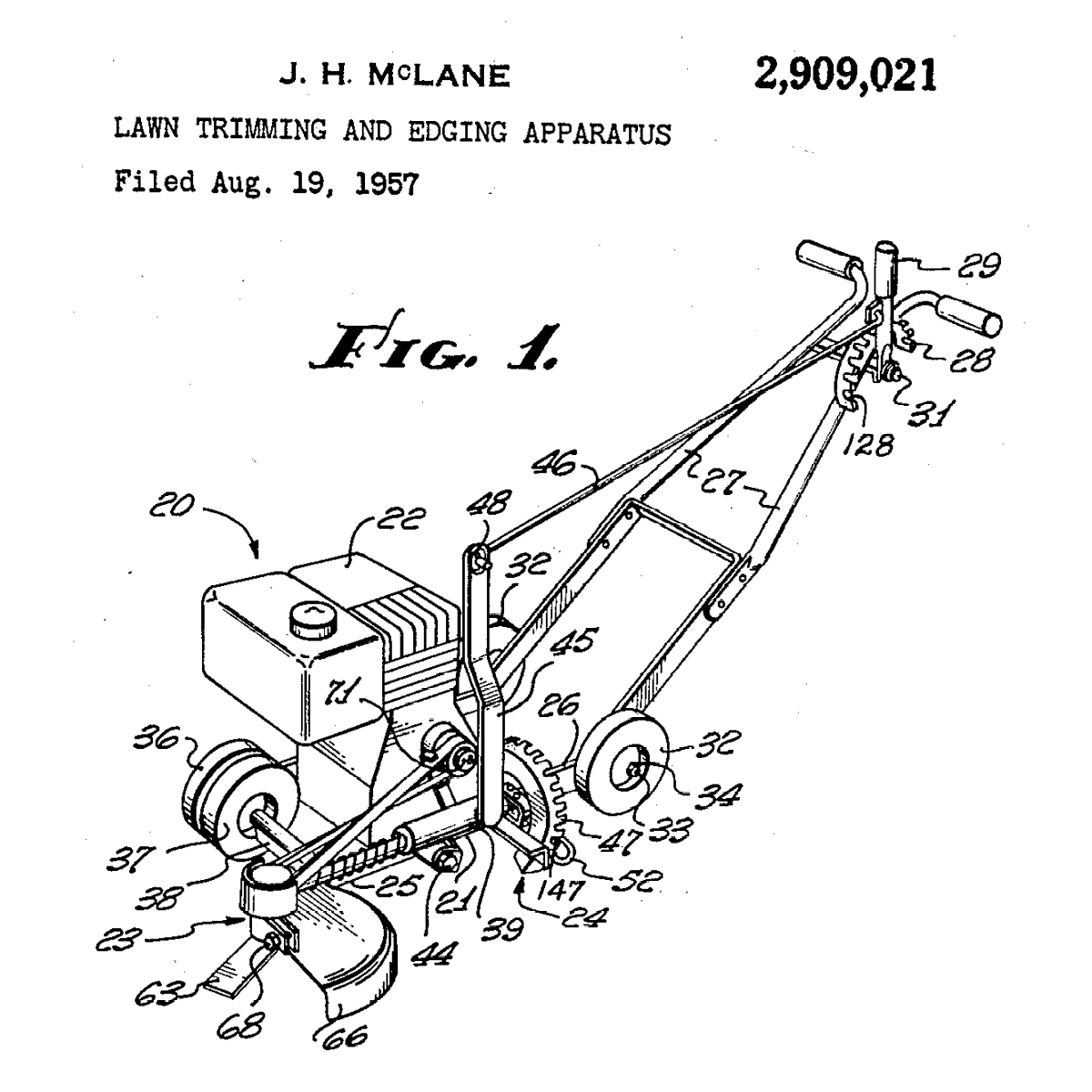
James McLane's innovative walk-behind edger.
James also realized that many homeowners owned separate edging and trimming machines. His dual-purpose design allowed the head to quickly convert from edging to trimming, effectively eliminating the need to maintain two separate machines. The dual front wheels, combined with dual edging-trimming capabilities, were a commercial home run. This 1957 architecture was so successful that it remains the foundational blueprint for the professional-grade walk-behind ME-550 and ME-120 edgers sold today. The success of the edgers allowed McLane to develop its reel mower line.
What Is a Reel Mower?
A reel mower is a specialized type of lawn mower. A rotating cylinder of blades (the reel) spins horizontal to the ground, like a rolling pin, passing very close (usually 2" or less cutting height) away from the ground. The blades of the reel gather grass as the reel turns, and as the reel passes extremely close - thousandths of an inch away - to a stationary flat blade (the bedknife), it cuts the grass just like a pair of scissors does. It is often contrasted against a traditional rotary mower.
- The Scissor Action: Unlike a standard rotary mower that "chops" grass with a high-speed spinning blade, the shearing action of a reel mower is far less traumatic for the plant, preventing the frayed, brown tips common with other mowers.
- Low-Height Maintenance: Homeowners with "premium" warm-season grasses like Bermuda and Zoysia use reel mowers to achieve a "carpet-like" finish. McLane mowers allow for precision cuts as low as 1/8", heights that would lead to scalping with a rotary mower.
- The McLane Difference: McLane stands out for its "Armor-Plate" steel reels and induction-hardened bedknives. While many modern brands have shifted toward lighter plastic components, McLane maintains a heavy-duty, tool-and-die engineering standard.
Is my vintage Craftsman reel mower or vintage John Deere edger a McLane?
During the 1970s and 1980s, McLane served as a major Original Equipment Manufacturer (OEM), producing "white label" machinery for iconic retailers like Sears and Montgomery Ward. Even when sold under a retailer's private name, the underlying build quality remained consistent with McLane's standards.
These OEM partnerships extended well into the 1990s, when its largest success was the Sears Craftsman 3.75 hp, 20" 7-Blade reel mower. While branded for Sears as Model 328.395900 (Model 328.395900 manual here), the mechanical DNA was unmistakably original McLane engineering. A review of the 1999 documentation reveals the use of standard internal components. For example, the 1999 Craftsman bedknife (Part 1103-A) and Clutch Control Rod (Part 1012-D) utilized the exact same designations as the McLane lineup. Because of this shared architecture, modern OEM replacements remain fully compatible with antique white-label mowers.
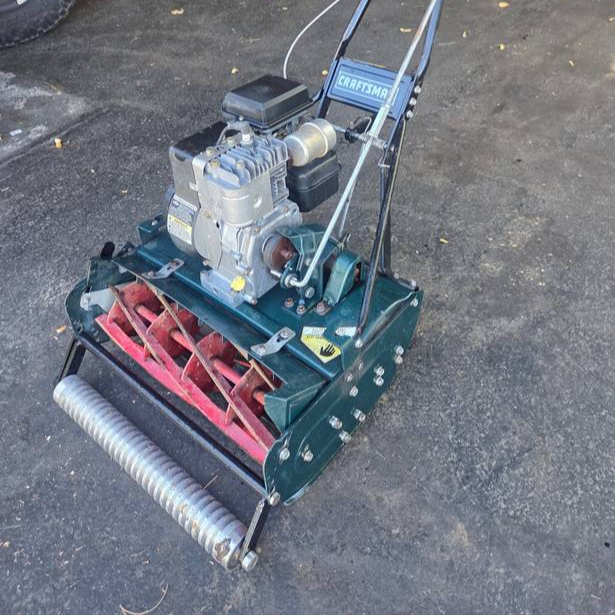
A rare 7-blade Craftsman unit from the 1980s. While branded for Sears, the frame and components are identical to the Paramount-era McLane models.
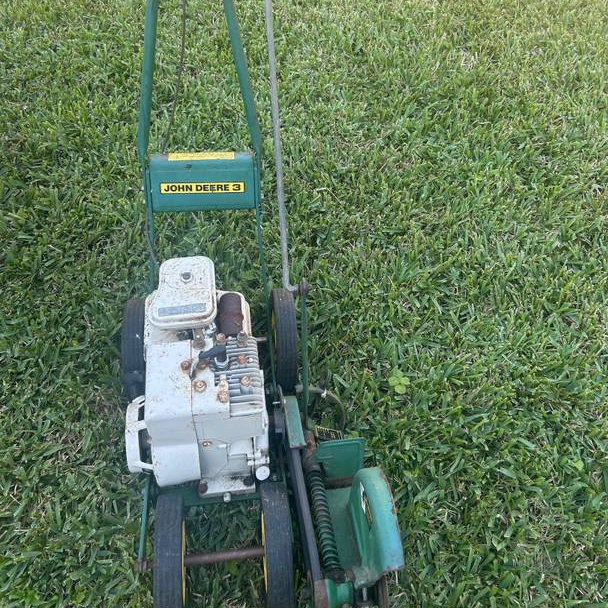
John Deere's 1970's walk-behind edgers were McLane edgers in disguise.
While these units featured the colors and decals of the respective department stores, the heavy-duty steel frames, drive systems, and blade geometry were pure McLane. This era allowed McLane's engineering to reach tens of thousands of American suburban lawns under various badges.
Is the Husqvarna LE475 Edger a McLane white label product?
While the LE475 edger (Model 966951101) (LE475 edger Model 966951101 manual here) features signature Husqvarna orange branding, its "mechanical DNA" is 100% McLane engineering. Produced from 2008 through 2020 (LE475 dealer archives here) this model is another prime example of an OEM partnership where the original manufacturer's identity was masked through a proprietary parts-coding system.
- The Part Number "Mask": Husqvarna replaced standard McLane part designations with their own 9-digit "505" prefix system. For example, the standard 4L-300 drive belt (McLane part 2058) became part 505289962, and the heavy-duty blade (McLane part 2059) was re-coded as 505289963.
- Engineering Proof: Despite the visual rebranding, the LE475 utilizes the exact cutterhead architecture and "scissor action" geometry found in the McLane ME-550 series.
- The Stability Patent: The machine prominently features the dual-front-wheel configuration, a design pioneered by James McLane's landmark 1957 filing to prevent the machine from digging into the lawn.
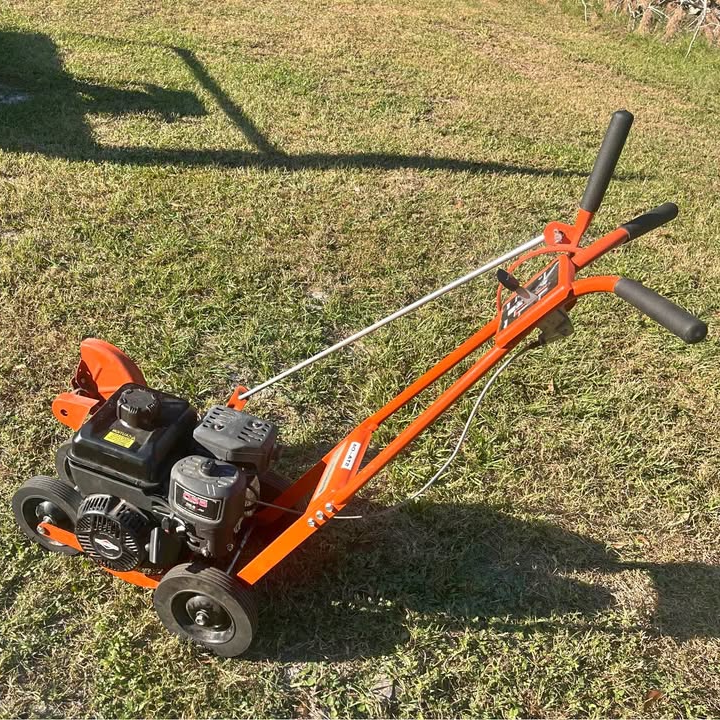
The LE475 is, at a glance, unmistakably a McLane product under the hood.
Owners of the LE475 often find that their local dealers list many components as "discontinued," yet because the frame is an original McLane build, these units remain fully serviceable today using factory-authorized McLane parts.
Did McLane make rotary mowers in the past?
While McLane is best known for precision reel cutting, the company's legacy out of Paramount, California, also includes a robust foray into the rotary market. The standout of this line was the Model N21-SP, a self-propelled 21-inch rotary mower built around a heavy-duty Steel Deck With Safety Ring (McLane N21-SP Operator's Manual). Far exceeding standard residential designs, the N21-SP featured a complex mechanical drive train consisting of a jack shaft, rear gear, and a heavy-duty chain connecting to a double idler sprocket. Rather than a centralized screw-crank system, the chassis cutting height was precisely managed by a dedicated "Height Adjustment Control Lever" connected to a network of steel tie rods and control rods.
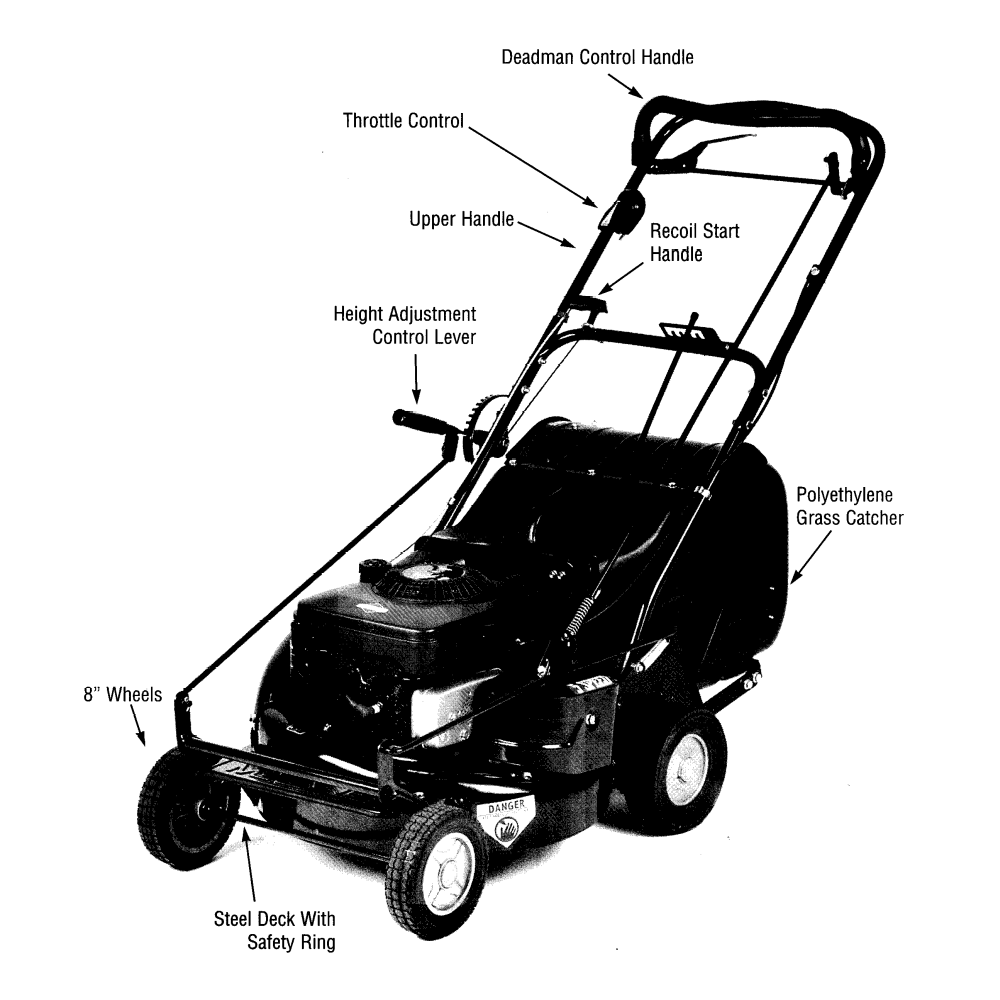
The N21-SP was McLane's foray into rotary mowers in the 1980s.
This era of rotary production represents a unique chapter in American manufacturing, where machines were built to be maintained rather than discarded. While the machine's legacy remained supported for decades, factory documentation shows that certain parts began to be discontinued as of November 1992 (McLane N21-SP Operator's Manual). Today, these rare rotary units are highly prized by collectors for the same mechanical durability that defines the modern McLane fleet. To this day, we still get calls from users of their 30+ year old McLane rotary mowers.
Who Owns McLane Lawn Mowers?
McLane Manufacturing is currently privately owned, following an acquisition in 2017. While the company has been a staple of American manufacturing for eight decades, its modern product development and national distribution are anchored by McLaneLawnMowers.com, which draws on decades of experience developed through Dolphin Outdoor Power Equipment (Dolphin OPE). In fact, the expansion of the residential reel mower line into the specialized tiers seen today was driven by a product development partnership with the team at McLaneLawnMowers.com.
Who Is Mark Salter and How Did He Shape the Modern McLane Fleet?
Mark Salter is a leading authority in the reel mower industry with over 40 years of technical and commercial experience. He founded Dolphin Outdoor Power Equipment in 1984 and launched McLaneLawnMowers.com in 1998.
Over the decades, Mark has personally overseen the sale and service of thousands of reel mowers. Today, McLaneLawnMowers.com serves as one of the most experienced sources for McLane products, parts, and technical knowledge, drawing on decades of experience developed through Dolphin Outdoor Power Equipment.
McLane vs. Tru-Cut: Why the Industry Shifted
From 2000 until 2020, Mark Salter was one of the primary distributors for Tru-Cut. His decision to move exclusively to the McLane platform in 2020 was driven by the mechanical potential of the McLane frame for modern, specialized customization.
By utilizing McLane's proprietary steel hardening process - originally refined by engineer Billy McLane in the 1980s - Mark was able to develop specialized models that offered a cleaner finish on dense warm-season and cold-season turf than the traditional competition.
How the Modern McLane Models Were Developed
Beginning in 2020, Mark Salter acted as a specialized distributor and engineering partner, using existing factory tooling to create a four-tier model lineup. This approach allowed for the creation of multiple specialized configurations rather than a single one-size-fits-all model, ensuring the machines remained predominantly American-made while offering golf-course precision to homeowners.
The Specialized Model Tiers
| Model Tier | Engineering Development | Best For |
|---|---|---|
| The 25" Classic | Expansion to a wider 25" deck width. | Larger residential properties. |
| The Low-Cut | Integration of the Grooved Front Roller and dropped rear axle. | Stable, striped 3/8" carpet cuts. |
| The Ultra Low-Cut | 10-blade reel, flat bedknife, and lowered mounting holes. | Precision, ultra-low cuts as low as 3/16". |
| The GK2 | Extended front adjustment screw for heights from 1/8" up to 2-1/8". | Pro-grade precision with home-use versatility. |
Exclusive Power: The Honda GX200 Commercial Engine
Mark identified that thick turf and hilly terrain required more torque than the standard GX160 engine could provide. He introduced the Honda GX200 Commercial-Industrial engine to the line - an upgrade that remains an exclusive offering at McLaneLawnMowers.com.
Are McLane Mowers and Edgers Red or Yellow and Red?
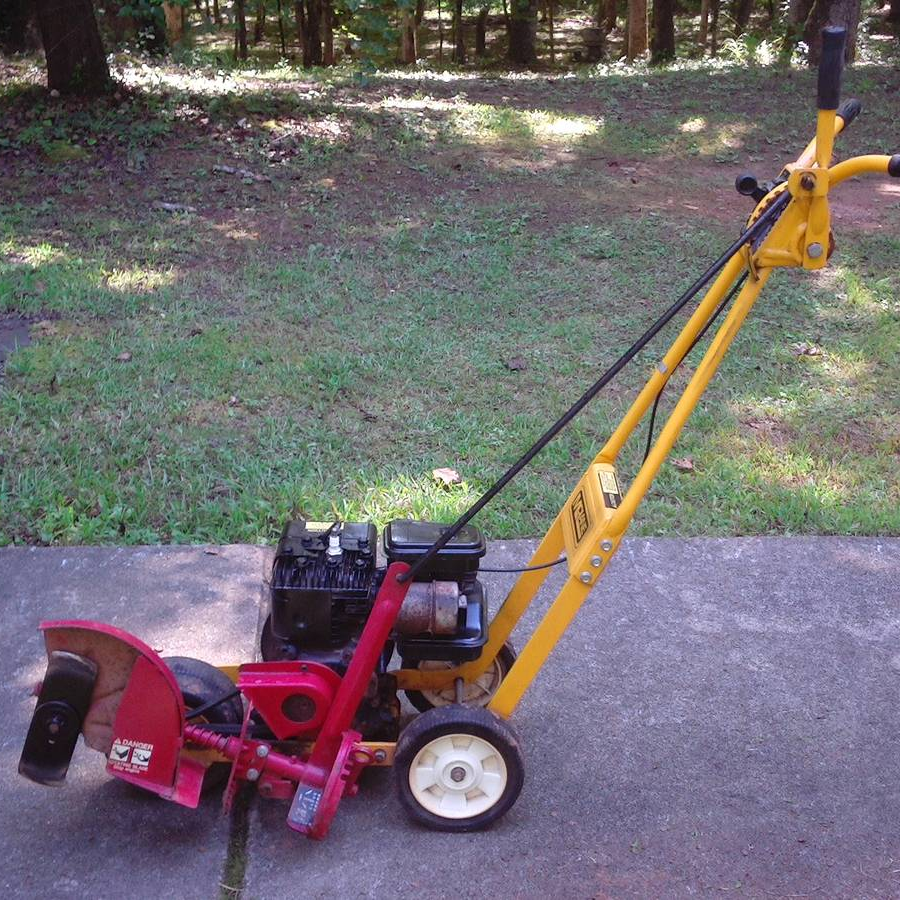
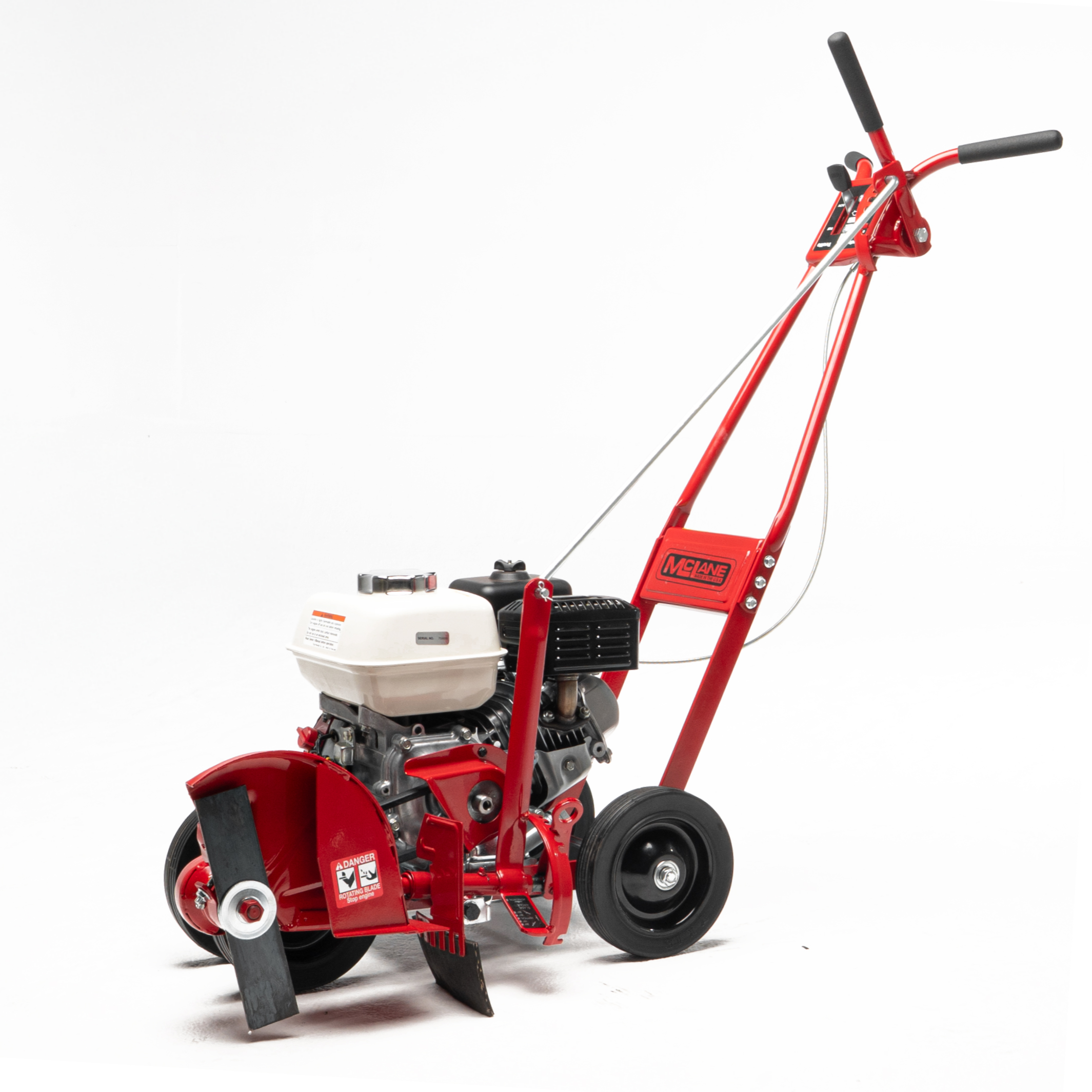
Modern McLane equipment manufactured after late 2021 features a unified all-red color scheme. Historically, McLane reel mowers were characterized by red bodies with contrasting bright yellow handles, while edgers had a red body and blade guard with yellow handles.
To identify a McLane vintage mower, look for these specific color configurations:
- Vintage and Antique Reel Mowers: Red body with bright yellow handles.
- Vintage and Antique Edgers: Red body and red blade guard with yellow handles.
Why did McLane switch to all red in late 2021?
The shift to an all-red palette was a strategic pivot led by Mark Salter in late 2021. This transition was designed to streamline manufacturing logistics and lean into the brand's identity as a premier American manufacturer. By adopting a bold, unified red, McLane effectively occupied the brand space left vacant by the decline of competitors like Tru-Cut.
By consolidating the visual identity into this high-energy hue, the 2021 model changes signaled a new era of high-performance engineering for the fleet available at McLaneLawnMowers.com.
The Future of McLane Engineering
McLane has a long-established history of innovation, and today, the factory is right at the cutting edge of reinvention. As the landscape of American lawn care shifts, McLane is evolving its "Armor-Plate" philosophy to meet new environmental and mechanical standards.
The Electric Transition
A significant driver of market change is California's SORE (Small Off-Road Engine) legislation (AB 1346), signed on October 9, 2021. This law effectively banned the sale of new gas-powered small engines into California by January 1, 2024, creating a massive market vacuum.
We expect McLane to respond with a new era of battery-powered lawn equipment. Given the substantial power requirements of a McLane electric reel mower, which must maintain a high-RPM reel while driving a heavy steel chassis, it is most likely that the electric transition begins with a McLane electric walk-behind edger. This would allow for a lighter battery footprint while maintaining the precision of the 1959 dual-wheel architecture.
Chain-Driven Commercial Evolution
Another area of potential innovation is the drive system. While McLane's residential models have traditionally been belt-driven for smoothness and ease of maintenance, the advanced commercial market prefers models with higher price points and higher performance chain drives. A chain drive has slightly lower power loss and slightly better torque transmission than a belt drive, at the cost of higher maintenance.
With the decline of several legacy competitors, we expect the brand to address the torque gap in the modern commercial market. A McLane chain-driven commercial reel mower would provide the durability required for golf-course-level maintenance at a homeowner's scale.
Why Buy from McLaneLawnMowers.com?
As an engineering-focused company, we provide more than just a product; we provide the history and expertise necessary to maintain these machines for a lifetime. Drawing on decades of experience from Dolphin Outdoor Power Equipment and the ongoing technical guidance of Mark Salter, we are one of the most experienced sources for McLane history, specialized models, and factory-authorized parts.
Frequently Asked Questions
Are McLane mowers still made in the USA?
Yes. McLane lawn mowers are still made in the USA. While many competitors are merely "assembled" in the US using foreign parts, McLane mowers are predominantly American-made by both parts and labor. McLane even manufactures its own internal components, such as sprockets.
What are the advantages of McLane being made in the USA?
The primary advantages are engineering precision and material quality. McLane machines are noticeably heavier than the competition because they utilize thicker, high-grade American sheet metal. This provides a more stable cutting platform and a longer machine lifespan than the thinner materials often found in imported models. Many McLane reel mowers are still running after 30 or even 40 years.
Are McLane parts readily available?
Yes. Because McLane manufactures its own parts in the USA, availability is significantly higher than that of the competition. When a machine needs maintenance, a McLane can be repaired quickly with domestic parts. In contrast, some competitors must ship spare parts from overseas locations like South Africa, leading to significant downtime during the mowing season.
MLA Citations:
- McLane, James H. Lawn Trimming and Edging Apparatus. US Patent 2,909,021, 20 Oct. 1959.
- Salter, Mark. "Our Story." McLaneLawnMowers.com, 2026, https://mclanelawnmowers.com/info.html.
- McLane Operator's Manual: Model N21 Combination Mulching/RearBagger Walk Behind Rotary Mower. McLane.
- Husqvarna. Operator's Manual: Edger/Trimmer Model LE475 / 966951101. Husqvarna, 2008.
- Husqvarna LE475 Inventory Archive. Diamond Outdoor Products, 2026.
- Sears, Roebuck and Co. Owner's Manual: Craftsman 3.75 HP 20" 7-Blade Power Propelled Reel Mower, Model No. 328.395900. Sears, Roebuck and Co., 22 Feb. 1999.
- California State Assembly. "Assembly Bill No. 1346: Air pollution: small off-road engines." California Legislative Information, 12 Oct. 2021.
- Salter, Mark. Personal interview. Conducted by Joshua Kronman, March 2026.